Minimalist nursery decor: a 7-element checklist
A minimalist nursery isn’t an empty nursery. It’s a room where every visible object has a job. Here are the seven elements that do that work — and the four things that quietly undo it.
The seven elements
1. One quiet base colour
Walls, floor and the largest furniture in the same warm neutral family: cream, oat, soft clay, pale grey. This is 60% of the room and it’s the reason everything else can afford to be interesting. See our palette guide for the exact splits.
2. One focal point
Pick a single thing the eye lands on when you walk in — usually the art above the crib, or a window. Everything else should be quieter than that one thing. Two focal points is the same as no focal point.
3. Art with space in it
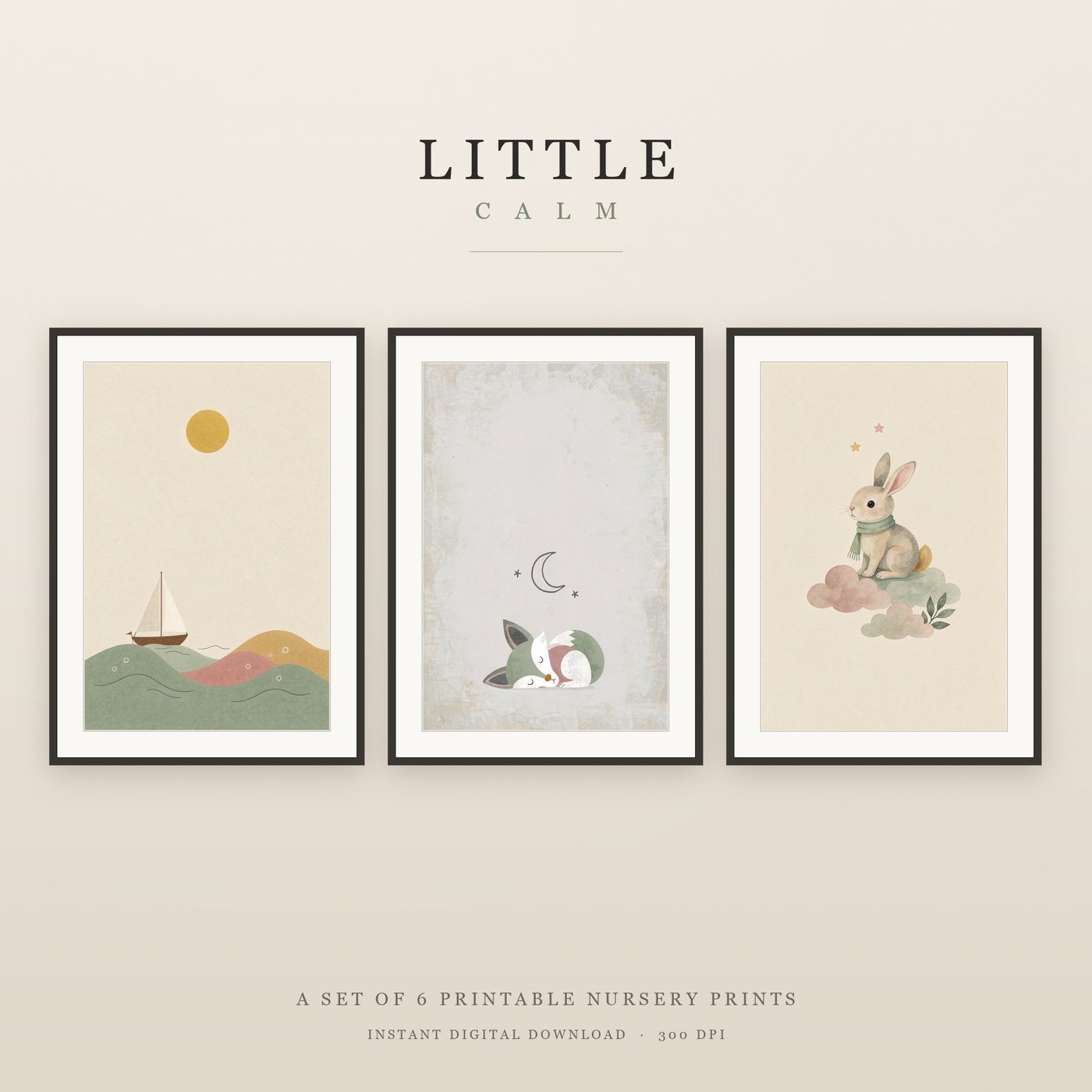
The most minimalist interiors still have art; the art itself is just calmer. Look for one subject, a muted palette, and a lot of empty background. Generous negative space in the artwork mimics generous empty wall in the room, which is what makes the whole thing feel airy.
4. Storage that hides the noise
Babies generate a shocking amount of equipment, and none of it is minimal. The answer isn’t to own less — it’s to own closed storage: drawers, baskets with lids, a covered bin. Open shelves in a nursery only work if you genuinely enjoy restacking them weekly.
5. One natural texture
A single warm material stops a minimalist room from feeling clinical: a jute rug, a rattan basket, a wooden toy, linen curtains, or a natural-wood frame. One is enough. Five textures is a style, and it isn’t minimalism.
6. Light you can dim
Practical and aesthetic: a warm, dimmable light source at low level (a small lamp on a dresser beats an overhead pendant at 2 a.m.). Warm bulbs — around 2700K — also make muted art look richer than cool white light does.
7. Something that will still work in five years
Choose at least one element that isn’t baby-specific: the rug, the armchair, the art. That single decision is what stops the whole room needing to be redecorated when your child starts school. Prints of mountains, waves, clouds or resting animals travel well to a bedroom or hallway later.
The four things that quietly undo it
- Matching everything. An entirely coordinated set of furniture, bedding and accessories reads as a catalogue page, not a calm room. Leave one thing slightly different on purpose.
- Themed characters everywhere. A theme repeated across bedding, curtains, wall stickers and a lamp is visual noise, and it dates within a year or two.
- Wall stickers instead of art. Stickers are tempting because they’re cheap, but they can’t be moved, they’re hard to remove cleanly, and they leave the walls looking busier rather than decorated.
- Too many small frames. Six tiny frames in mismatched sizes will always look more cluttered than one print in the right size. Fewer, bigger, matched.
A cheap way to get there
The most common reason a minimal nursery stalls is the art budget — framed art is expensive, and buying six matching pieces feels out of reach. Printable downloads break that deadlock: you choose one coordinated set, print it in the sizes your frames need, and pay for the artwork once rather than six times. Printed on matte paper and hung in matching frames, the result is indistinguishable from a much more expensive purchase.
The one-hour version: clear every surface in the room, then put back only three things per surface. Choose one focal point. Match all frame colours. That alone changes a cluttered nursery more than any purchase.
Little Calm — six prints designed for exactly this kind of room: muted palette, one subject per print, plenty of empty space. Five aspect ratios, 300 DPI, printable up to 20x30 in.
Get Little Calm — $19.99